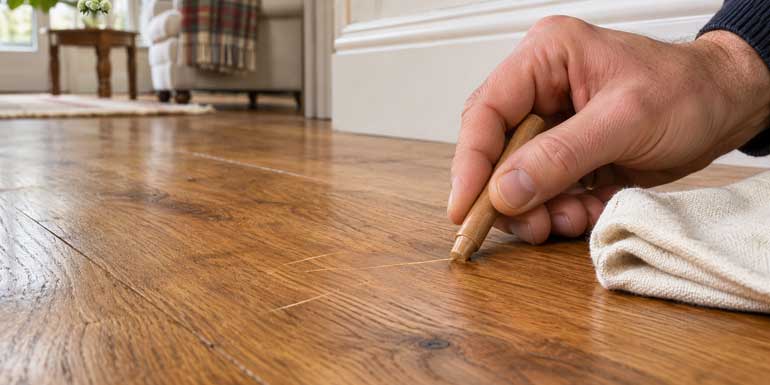
Yes, in many cases. Light and moderate scratches can often be repaired without sanding the whole floor. The fix depends on how deep the scratch goes and what finish your floor has. Surface marks in the lacquer or oil usually respond well to cleaning, buffing or a spot repair. Deep gouges that cut into the timber are harder, and a full floor sanding may be the only way to get an even result.
This guide explains how to tell the difference, which no-sanding methods work, and when it’s worth calling a specialist.
First, Work Out How Deep the Scratch Is
Before you buy anything, check what you’re dealing with. Many marks that look like scratches are only scuffs sitting on top of the finish.
The fingernail test: run a fingernail gently across the mark.
- If your nail glides over it, the damage is in the surface finish only.
- If your nail catches slightly, the scratch has reached the top layer of the finish or wood.
- If your nail drops into a groove, it’s a deep scratch or gouge in the timber itself.
Also look at the colour. A pale or whitish line usually means the finish is damaged. A dark line often means moisture or dirt has got into bare wood.
Which Repair Suits Which Scratch?
| Type of damage | What it looks like | Repair without sanding? |
|---|---|---|
| Surface scuffs | Grey or pale marks, no groove | Yes, clean and buff |
| Light scratches | Fine lines, nail barely catches | Yes, polish or touch-up |
| Moderate scratches | Visible lines through the finish | Often, with filler or a spot repair |
| Deep scratches and gouges | Groove cut into the wood | Sometimes, but sanding gives better results |
| Widespread scratching | Dull, worn patches across the room | Rarely, usually needs refinishing |
Methods That Work Without Sanding
1. Clean the Floor Properly
It sounds too simple, but dirt and grit often look like scratches. Sweep, vacuum with a hard-floor head, then clean with a damp mop and a pH-neutral wood floor cleaner. Let it dry fully and look again. A surprising number of marks disappear.
2. Use a Wood Floor Polish or Restorer
For fine surface scratches on a lacquered floor, a quality floor restorer or polish fills the marks and brings back the sheen. Choose one that suits your finish. Using the wrong product can leave streaks or make future recoating difficult.
3. Try a Wax Filler Stick or Touch-Up Marker
For individual scratches, a wax filler stick or colour-matched marker is the quickest fix.
- Match the colour to the surrounding boards, testing in a hidden corner first.
- Rub the filler into the scratch and wipe off the excess across the grain.
- Buff gently with a soft cloth.
This works best on light to moderate scratches. It hides the mark rather than removing it, but on a busy floor that’s often enough.
4. Spot Repair on Oiled Floors
Oiled floors are the easiest to repair without sanding. Because hard wax oil sinks into the wood rather than sitting on top, you can treat just the damaged area.
- Clean the spot and let it dry.
- Rub a small amount of matching oil into the scratch with a cloth or pad.
- Feather it into the surrounding area and buff.
- Leave it to cure before walking on it.
This is one reason many people in Chelsea homes with period boards choose oil: it ages well and patches without a full refinish.
5. Screen and Recoat (Buff and Recoat)
If a lacquered floor has dull, scratched areas across a whole room but the wood itself is undamaged, a screen and recoat can help. A machine lightly abrades the old finish so a fresh coat bonds to it, which restores the protective layer and the shine.
It isn’t sanding in the traditional sense, because it doesn’t remove the finish or any wood. It does need the right equipment and compatible products, so it’s usually best left to a professional. Our team offers sealing, staining and recoating as part of our flooring services.
6. Fix Deeper Scratches with Filler
For a deeper groove, use a wood filler or hardwax filler that matches your floor. Press it in, level it with a plastic scraper, let it harden and buff it back. Results vary. On a light oak floor a good match can be almost invisible. On darker or stained boards, matching is harder.
When You Can’t Avoid Sanding
Some situations genuinely need sanding, and trying to avoid it can make things worse:
- Deep gouges that run across large areas
- Dark stains where water or pet urine has soaked into the wood
- Worn finish in high-traffic areas such as hallways and doorways
- Mismatched repairs from earlier DIY attempts
- Many scratches spread across the floor
In those cases, spot fixes tend to look patchy. A proper floor sanding and refinishing job removes the damage, evens out the colour and gives the whole floor a consistent finish. Sanding also deals with loose or squeaky boards and damaged spots at the same time, so you often don’t need to pay for separate repairs. Worn stairs can be sanded and refinished too, so they match the rest of the floor.
If you have original parquet or herringbone, specialist parquet floor sanding is the safest route, because the blocks run in different grain directions and need careful handling.
Be careful with engineered wood floors. The top layer is thinner, so check the wear layer thickness before any sanding is considered. Our guide to engineered wood floor sanding explains how much material can safely be removed, and a specialist can measure it for you.
How to Prevent Scratches Coming Back
Whichever repair you choose, a few habits will protect it:
- Fit felt pads under chairs, tables and sofas
- Use doormats at entrances to catch grit
- Keep pets’ nails trimmed
- Avoid dragging furniture, and lift it instead
- Vacuum regularly with a hard-floor attachment
- Don’t wear stiletto heels or outdoor shoes on the floor
Good floor care and maintenance extends the life of your finish and puts off the next refinish by years.
Should You Repair It Yourself or Call a Professional?
DIY is fine for surface scuffs, light scratches and small spot repairs. It’s cheap and low-risk if you test products in a hidden spot first.
Call a professional when:
- The scratches are deep or widespread
- You have a valuable period floor, such as original parquet or herringbone
- You’re unsure what finish the floor has
- Previous repairs have gone wrong
- You want a result that’s consistent across the whole room
In Chelsea, where many floors are original boards in Victorian houses and mansion flats, getting advice before you start can save a costly mistake. An expert can often identify the finish, assess the damage in minutes and tell you honestly whether you need sanding or not. You can also check our prices to see what a full refinish costs compared with repeated patching, or ask an expert about your floor.
Frequently Asked Questions
Can you fix scratches on a wood floor without sanding?
Yes, if they’re shallow. Cleaning, polish, wax filler, touch-up markers and spot oiling can all work. Deep gouges usually need more.
Does vinegar or olive oil remove scratches?
They may disguise very fine marks for a short time, but they can leave residue and interfere with later refinishing. A product made for wood floors is the safer choice.
Can scratches on a lacquered floor be repaired without sanding?
Light scratches can be buffed, filled or recoated. Deep scratches through the lacquer often need the area sanded and refinished to blend in.
Is it cheaper to repair or refinish?
Spot repairs cost less up front. But if damage is widespread, repeated patching can cost more than one proper sand and refinish.
How do I know if my floor needs sanding?
If the scratches are deep, the finish is worn through, or the colour is uneven across the room, sanding is usually the better option. A free assessment from a floor specialist will confirm it.
Need Help With Scratched Floors in Chelsea?
Not sure whether your floor can be saved without sanding? Our team can inspect the damage, explain your options and quote for the right repair, whether that’s a quick spot fix or a full restoration. Request a free quote or call us on 020 7036 0624 to book a no-obligation visit.